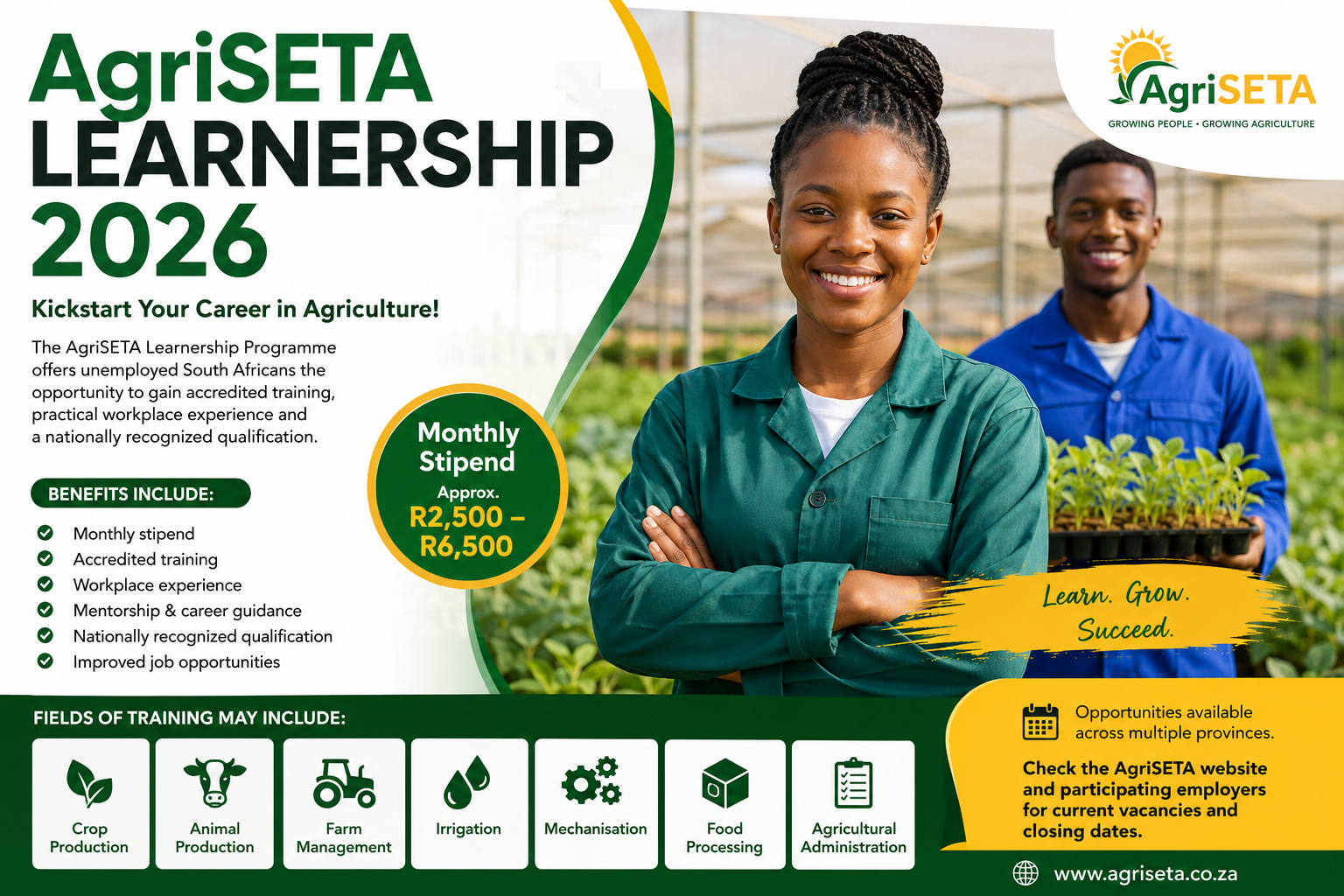
AgriSETA Learnership 2026: Salary, Monthly Stipend, Eligibility Requirements and How to Apply Before the Closing Date
Introduction
For thousands of unemployed South Africans, finding meaningful work without experience remains one of the country’s biggest challenges. Many employers expect applicants to have practical skills, yet gaining those skills often requires employment first. Learnership programmes have become one of the most effective ways to bridge this gap.
Among the country’s leading skills development initiatives is the AgriSETA Learnership Programme 2026, which provides unemployed youth and employed workers with an opportunity to receive accredited training while earning practical workplace experience.
Although opportunities vary between employers and provinces, AgriSETA-supported learnerships continue to play an important role in developing South Africa’s agricultural workforce. Participants receive nationally recognised qualifications, workplace training, and a monthly stipend during the programme.
If you’re considering applying, understanding the eligibility requirements, application process, expected stipend, and available training fields can significantly improve your chances of success.
Key Highlights
- Fully accredited South African learnership programme
- Monthly stipend paid by participating employers
- Nationally recognised qualifications
- Workplace experience combined with classroom learning
- Available in various agricultural sectors
- Suitable for unemployed South African youth
- Opportunities available across multiple provinces
- Applications depend on participating employers and training providers.
What Is the AgriSETA Learnership Programme?
The Agricultural Sector Education and Training Authority (AgriSETA) is responsible for developing skills within South Africa’s agricultural sector. As one of the country’s SETAs, its mandate includes supporting education, vocational training, and workforce development through accredited programmes.
Rather than recruiting learners directly for every opportunity, AgriSETA works with accredited employers, training providers, commodity organisations, agricultural businesses, cooperatives, and industry partners that offer learnership opportunities throughout the year.
These programmes combine:
- Classroom-based theoretical learning
- Practical workplace training
- Industry mentoring
- Skills assessments
- National qualification certification
Participants gain valuable work experience while studying toward qualifications registered on the National Qualifications Framework (NQF).
Why AgriSETA Learnerships Matter
Agriculture remains one of South Africa’s largest employment sectors, supporting food production, exports, rural development, and economic growth.
However, employers increasingly require workers with formal skills and recognised qualifications.
AgriSETA learnerships help address this challenge by preparing participants for careers in:
- Crop production
- Animal production
- Farm management
- Agricultural processing
- Irrigation
- Food safety
- Agricultural administration
- Mechanisation
- Forestry
- Grain handling
- Agricultural logistics
Graduates often improve their employability because they leave with both practical experience and recognised qualifications.
AgriSETA Learnership 2026 Salary and Monthly Stipend
One of the most frequently asked questions concerns payment during the programme.
Unlike permanent employment, learnership participants receive a monthly training stipend rather than a salary.
The exact amount varies depending on:
- Employer
- Qualification level
- Funding allocation
- Programme duration
- Employment status
In many AgriSETA-supported programmes, learners may receive a monthly stipend that commonly ranges between approximately R2,500 and R6,500, although some programmes may offer different amounts depending on available funding and contractual arrangements.
Applicants should always verify the stipend stated in the official vacancy advertisement before applying.
Additional Benefits Learners May Receive
Besides the monthly stipend, participants may receive:
- Accredited training
- Workplace experience
- National qualification
- Mentorship
- Skills development
- Career guidance
- Increased employability
- Networking opportunities
- Industry exposure
Some employers may also provide:
- Personal protective equipment
- Training materials
- Uniforms
- Transport assistance
- Meals during training
Benefits differ between organisations.
Who Can Apply?
Eligibility requirements vary according to each employer and learnership.
However, applicants are commonly expected to meet the following criteria.
Basic Requirements
Applicants are generally required to:
- Be South African citizens.
- Possess a valid South African ID.
- Be unemployed when required by the programme.
- Have Grade 12 (Matric) or the minimum qualification specified
- Meet the age requirements where applicable.
- Be willing to complete workplace training.
- Demonstrate an interest in agriculture.
Some programmes may also consider applicants with Grade 10 or Grade 11 depending on the qualification level.
Fields Available Under AgriSETA
AgriSETA supports training across a broad range of agricultural industries.
Common fields include:
Primary Agriculture
- Crop production
- Vegetable farming
- Fruit farming
- Livestock production
- Poultry farming
- Dairy farming
Agricultural Processing
- Food processing
- Packaging
- Quality assurance
Agricultural Business
- Farm administration
- Supply chain
- Marketing
- Agricultural finance support
Technical Fields
- Irrigation
- Mechanisation
- Equipment maintenance
- Tractor operations
The available programmes differ each year depending on employer demand and funding.
Programme Duration
Most AgriSETA learnerships last between:
- 12 months
- 18 months
- 24 months (for certain qualifications)
Throughout the programme, learners complete both theoretical instruction and practical workplace experience.
Required Application Documents
Applicants are usually asked to submit:
- Updated CV
- Certified copy of South African ID
- Certified Matric certificate or highest qualification
- Academic transcripts where required
- Proof of residence (if requested)
- Driver’s licence (for selected programmes)
Only submit documents requested in the official advertisement.
How to Apply for the AgriSETA Learnership 2026
Applications are generally submitted through participating employers or accredited training providers rather than directly through AgriSETA.
The typical application process includes:
Step 1
Monitor official AgriSETA communications and participating employers for available learnership advertisements.
Step 2
Carefully read all eligibility requirements.
Step 3
Prepare certified supporting documents.
Step 4
Complete the application form accurately.
Step 5
Submit your application before the advertised closing date.
Late or incomplete applications are usually not considered.
Closing Dates
There is no single national closing date for all AgriSETA learnerships.
Each employer sets its own application deadline.
New opportunities may become available throughout the year depending on funding and recruitment needs.
Applicants should regularly monitor official announcements.
Common Mistakes That Reduce Your Chances
Many applications are unsuccessful because candidates:
- Submit incomplete forms
- Forget certified documents
- Miss the closing date.
- Use outdated contact details.
- Apply without meeting minimum requirements.
- Ignore application instructions
Carefully reviewing your application before submission can improve your chances.
Career Opportunities After Completion
Completing an AgriSETA learnership does not automatically guarantee permanent employment.
However, graduates often become more competitive for roles such as:
- Farm worker
- Farm supervisor
- Agricultural assistant
- Production assistant
- Irrigation assistant
- Packhouse worker
- Agricultural administrator
- Quality controller
- Livestock assistant
- Agricultural technician (where qualifications allow)
Many employers value applicants with practical workplace experience gained through accredited learnerships.
South Africa’s Agricultural Skills Demand
Agriculture continues to support employment across rural and urban communities while contributing to food security and exports.
Government and industry stakeholders have consistently identified skills development as essential for improving productivity and expanding employment opportunities in the sector.
Programmes supported by AgriSETA aim to help address skills shortages by preparing workers for occupations aligned with industry needs. For young people interested in farming, agribusiness, food production, or agricultural technology, learnerships can provide a structured pathway into the sector.
Expert Analysis: Is an AgriSETA Learnership Worth It?
From a career development perspective, AgriSETA learnerships offer several advantages over applying for entry-level jobs without formal training.
Participants gain recognised qualifications alongside practical workplace experience, making them more competitive in future recruitment processes. While the monthly stipend is intended to help cover basic training-related expenses rather than serve as a full salary, the combination of structured learning and hands-on experience can provide long-term value.
Prospective applicants should also be cautious of unofficial advertisements requesting payment. Legitimate AgriSETA-supported learnerships generally do not charge application fees. Always confirm opportunities through official channels or accredited employers.
Frequently Asked Questions
Is the AgriSETA Learnership free?
Yes. Legitimate AgriSETA-supported learnerships generally do not require applicants to pay application or training fees.
Does AgriSETA guarantee employment?
No. Completing a learnership improves employability but does not guarantee permanent employment.
How much is the monthly stipend?
Stipends vary by employer and programme. Many fall within an approximate range of R2,500 to R6,500 per month, but applicants should rely on the amount stated in the official advertisement.
Can I apply without Matric?
Some programmes may accept Grade 10 or Grade 11, while others require Matric. Eligibility depends on the specific learnership.
Where can I find official vacancies?
Monitor the official AgriSETA website, accredited employers, agricultural companies, provincial agriculture departments, and reputable South African careers portals for new opportunities.
Conclusion
The AgriSETA Learnership 2026 offers an important opportunity for South Africans seeking practical experience and recognised qualifications within the agricultural sector. While available programmes, stipends, and entry requirements vary between participating employers, the initiative remains one of the country’s key pathways into agriculture-related careers.
Applicants can strengthen their chances by preparing their documents early, checking official vacancy notices regularly, and submitting complete applications before the relevant closing dates. For many young people and first-time job seekers, an AgriSETA-supported learnership can provide valuable industry exposure and a foundation for future employment.
Reliable Sources and References
- AgriSETA (Agricultural Sector Education and Training Authority): https://www.agriseta.co.za
- Department of Higher Education and Training (DHET): https://www.dhet.gov.za
- South African Qualifications Authority (SAQA): https://www.saqa.org.za
- National Skills Authority (NSA): https://www.nationalskillsauthority.org.za
Author Expertise
This article was prepared using publicly available information from South African skills development authorities and official guidance on SETA learnerships. It is intended to help job seekers understand how AgriSETA-supported learnerships generally operate and should not replace information published in official vacancy advertisements.
Editorial Transparency
This content is independently written for informational purposes and is not sponsored, endorsed, or affiliated with AgriSETA or any participating employer. Details such as stipend amounts, eligibility criteria, programme availability, and closing dates may change over time. Readers should verify the latest information through official AgriSETA communications and the specific employer or training provider advertising the learnership before applying.