
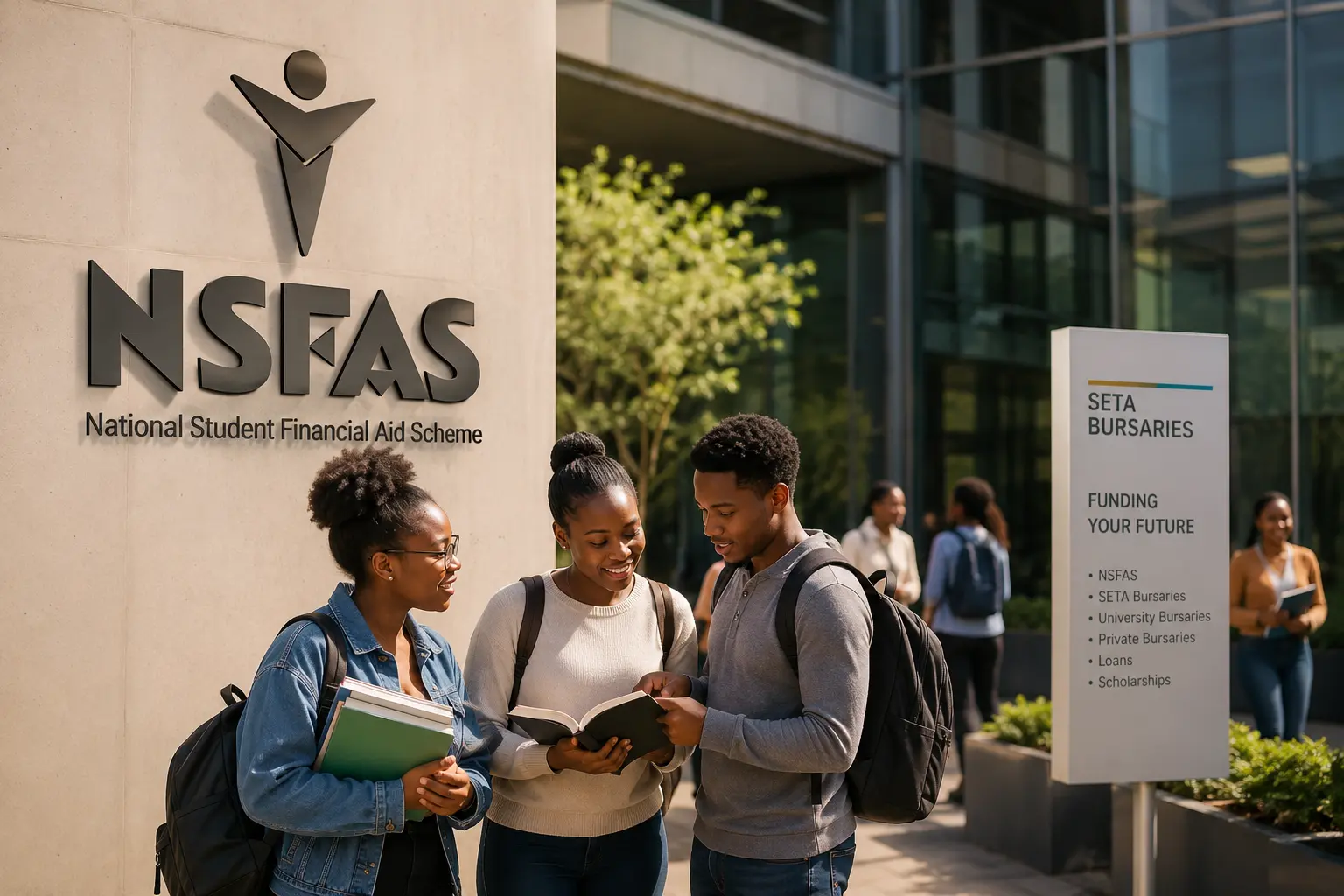
South African students who are unable to fund their own studies have several options to choose from, but there is no one-size-fits-all student grant.
For those who qualify, the National Student Financial Aid Scheme (NSFAS) represents the biggest student funding programme in South Africa, but bursaries, financial aid, government-sponsored opportunities, company-sponsored options, and other funds can help offset the cost of tertiary education.
The options will vary depending on which institution a student wants to attend, their household income, the course they want to study, and the requirements of their preferred funding organisation.
NSFAS is a good starting point for most students
NSFAS provides students with funding opportunities for those who wish to study at public universities or colleges.
The organisation reports that students who are studying from a household with an annual income of less than R350,000 qualify for their bursary scheme, while students with disabilities may earn up to R600,000 per annum.
NSFAS also reports that active recipients of SASSA grants automatically qualify for their bursary scheme on a means-tested basis.
Keep in mind that this does not guarantee that a student will receive funding, as eligibility depends on several other criteria.
Apply for NSFAS funding here
What does NSFAS typically cover?
Depending on a student’s financial needs and funding criteria, NSFAS can help fund students’ studies in several ways, including:
- Tuition fees
- Registration fees
- Residence
- Travel
- Study manuals
- Study or living allowances
These allowances and limits are not necessarily the same for every student, so it is best to consult the latest NSFAS funding guidelines and limits.
Setas offer bursaries for students in specific fields of study
For students who do not qualify for NSFAS funding, Sector Education and Training Authorities (SETAs) offer bursaries to students who wish to study specific fields of study.
These means-tested bursaries typically fund students’ studies in particular qualifications or fields of study, depending on the needs of a specific economic sector.
SETAs typically fund students who wish to study:
- Engineering
- Information communication technology
- Health sciences
- Natural agriculture science
- Finance
- Construction
- Education
- Tourism, among others
It is important to remember that every SETA has different eligibility requirements, qualifying fields of study, funding criteria, and deadlines, so it is best to speak to one’s preferred SETA to learn more about their bursary programme.
Universities can have their own bursaries and scholarships
Students should always speak to their preferred university about the available bursaries, scholarships, and financial aid opportunities because every university has its own funding programmes.
In most cases, financial-aid programmes will take a student’s financial needs, athletic or academic prowess, and other factors into consideration.
While many universities offer similar packages, there are also different eligibility requirements and guidelines for every funding scheme.
A student should not be discouraged if they are not eligible for one university’s financial-aid package because there could be better funding opportunities at another university.
Funza Lushaka Bursary covers teaching degrees
Those who want to pursue a career in teaching should apply for the Funza Lushaka Bursary, which covers teaching degrees at public institutions.
However, it is important to keep in mind that recipients of this bursary have to complete a teaching placement at a public school for every year of their bursary.
As with most other bursaries, it is best to speak to a financial-aid officer to learn more about the latest eligibility requirements and conditions before applying.
Student loans allow students to pay back their funding with interest
Another good funding option for students to consider is a student loan.
Unlike a bursary, a student loan requires a borrower to pay back the loan, plus interest, to the lending organisation.
Most banks and financial institutions offer student loans, but it is important for a student to compare the following before taking on debt:
- Interest rates
- Fees
- Repayment periods
- Whether and when repayments start
- Other conditions and terms
- What happens if a student decides to withdraw from their studies
NSFAS also offers a student-loan programme to eligible students who do not qualify for a bursary due to their household income.
The organisation publishes information about their student-loan funding on their website.
Alternative funding options for students who earn too much for NSFAS
Some students believe that they cannot pursue tertiary studies if they do not qualify for NSFAS funding, but this is not true.
There are several alternative options for students who do not qualify for NSFAS bursaries, including SETA bursaries, university bursaries, company-funded scholarships, and others.
The government has acknowledged that bursaries from SETAs open the door to tertiary education for students who do not qualify for NSFAS bursaries, including those in the “missing middle”.
NSFAS reported that its bursary programme only funds the needs of more than 10% of South Africa’s tertiary students, so it is always a good idea to explore other funding options.
Remember that financial-aid eligibility does not always mean university admission
Students should always remember that being eligible for financial aid does not always mean that they will be admitted to a university or college.
They have to complete the following two-step process:
- Apply for admission to their preferred institution
- Apply for financial aid or a bursary
It is important to remember that admission and bursary applications have separate deadlines, so a student should not wait to apply for tertiary education just because they are still waiting for a response to their bursary application.
How to find valid funding sources
A student can start looking for bursaries and other funding opportunities by determining the field of study and institution that they want to join, including:
If a student wants to attend a university:
Consult the NSFAS eligibility guidelines and apply for bursaries at their preferred institution to offset their study costs, including financial-aid programmes from their preferred university.
If a student wants to attend a TVET college:
Consult the NSFAS eligibility guidelines and apply for relevant bursaries at their preferred SETA or institution.
If a student wants to pursue a career in teaching:
Consult the NSFAS eligibility guidelines and apply for the Funza Lushaka Bursary, if eligible.
Other considerations
If a student does not qualify for an NSFAS bursary, they should consider SETA bursaries, university bursaries, company bursaries, scholarships, and student loans, if necessary.
Students should always remember to apply for bursaries well in advance and adhere to the application guidelines and supporting-document requirements of their preferred bursary programme.
Documents required by bursary providers
Every bursary, scholarship, or funding programme has different requirements, but prospective applicants typically have to submit the following documents:
- South African ID documents
- Proof of income
- Academic records
- Proof of university or TVET admission
- Parent or guardian details
- Disability assessment
- Any other documents specified by the bursary provider
Students should never assume that the requirements for one bursary programme are the same for another one, so it is always best to familiarise themselves with the requirements of their preferred bursary programme.
Be wary of bursary scams
It is important for students to be wary of bursary scams when searching for bursary and funding opportunities.
Unfortunately, there are people who take advantage of students’ need for financial assistance by asking for money in exchange for a bursary or by stealing students’ personal information.
Some warning signs that a student should look out for include:
- Anyone asking for money to facilitate a bursary
- Claims that a student qualifies for NSFAS funding automatically
- Anyone asking for a banking PIN or password
- Unofficial websites that ask for personal information
- Anyone claiming that they can assist with a bursary application “more quickly”
- Anyone asking for money in exchange for an interview
NSFAS and most legitimate private bursary providers publish their guidelines on their websites, so students should always access bursary information through the official website of their preferred organisation.
Frequently asked questions
Is there a student grant in South Africa?
South Africa does not have a student grant that everyone qualifies for, but every student can apply for bursaries, funding programmes, scholarships, or student loans to help fund their tertiary studies.
What is NSFAS?
NSFAS represents a government agency that provides financial assistance to students at public universities and TVET colleges.
What is the NSFAS income bracket?
The household-income threshold for the NSFAS bursary is R350,000 per annum, whereas students with disabilities may earn up to R600,000 per year.
Is there funding available for students who do not qualify for NSFAS?
Yes, there are several bursary, scholarship, and financial-aid options available for students who do not qualify for an NSFAS bursary.
Are SETA bursaries only available to unemployed students?
No, this is a common misconception, as every SETA has its own bursary guidelines and requirements.
Do bursaries have to be paid back?
A bursary typically differs from a commercial loan, as it typically does not have to be paid back, but some bursaries do have conditions, so it is important for a student to understand the fine print before accepting a bursary.
The best place to start
NSFAS represents the best place to start for most South African students, but it should not be the only option that a student explores.
SETA bursaries and university financial-aid schemes are also good options for students who do not qualify for an NSFAS bursary or want additional funding.
Always apply for funding through the appropriate channels and keep track of the requirements and deadlines for every bursary scheme that a student applies for.
References
This article was put together using information from government education departments and official NSFAS resources.
NSFAS official website
South African government: NSFAS financial assistance
Basic Education funding studies
Editorial policy
Our education and careers content is created to offer relevant, reliable, and independent information for South African students, parents, learners, and job seekers. We make every effort to use government, institutional, and programme resources when possible, and we never add any figures, requirements, or benefits that have not been officially published.
The information that we publish should not be used as an application or guarantee that a student will receive funding.
Disclaimer
This article is for informational purposes only and is not an application for any form of financial assistance. A student’s eligibility for bursaries and other forms of student funding depends on the requirements and guidelines of the funding organisation.
Student awareness
Do not pay an unofficial agent to assist you with NSFAS, SETA, or other bursary applications.
Students should always protect their personal information and only deal with official funding organisations when applying for bursaries, scholarships, or financial assistance.