
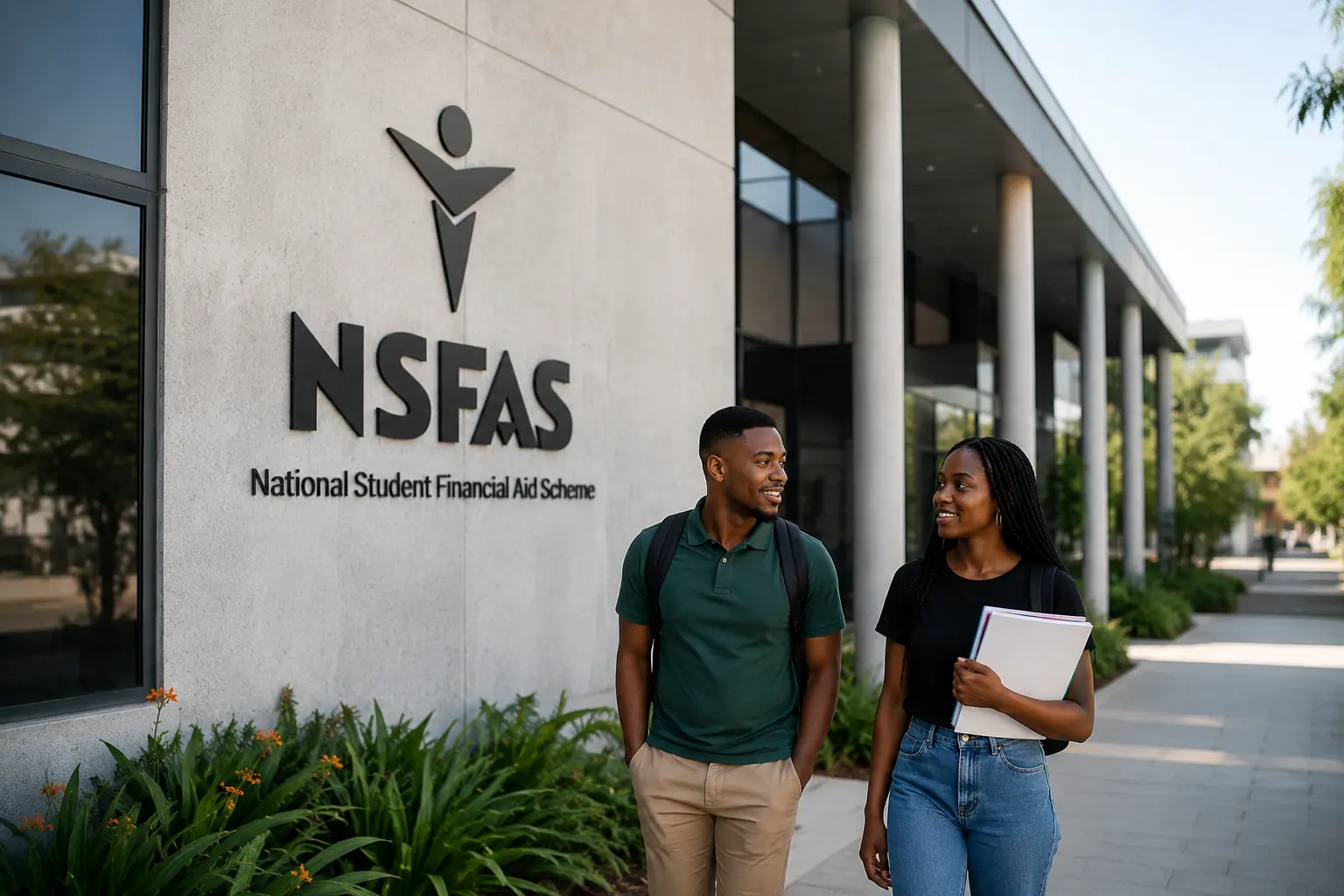
A proposal to graduate students’ debt repayment and link it to their income has reignited a debate over funding for NSFAS and sustainability in higher education.
Sioux McKenna, director of the Centre for Postgraduate Studies at Rhodes University, has called for a more robust system of recovering payments from graduates. Her comments come as universities grapple with unpaid student debt and NSFAS faces a R15 billion shortfall in its budget.
She stopped short of saying that SARS is already deducting payments from graduate salaries to help fund NSFAS.
The proposal has reignited a discussion about student debt repayment and the funding of higher education in general.
Why graduate repayments are back in the spotlight
The discussion comes at a time when concerns about post-school education finances are mounting.
According to the May report by Parliament’s Portfolio Committee on Higher Education, total outstanding student debt in South Africa’s post-school system amounted to R59 billion, with R29 billion of that owing to NSFAS. Universities South Africa provided the figures to the committee.
More recently, concerns have been raised about the pressure that unpaid student debt was placing on individual universities. That is why the proposal to bolster graduate repayments has re-emerged in debate.
NSFAS is facing a major funding shortfall
Higher Education and Training Minister Buti Manamela warned Parliament in August that NSFAS was facing a R15 billion shortfall.
“This deficit has escalated from about R2.5 billion in 2018 to R13.5 billion in 2025 and is expected to reach about R15 billion in 2026,” he said. The reason for the increase was that more students were accessing higher education and TVET colleges, despite a slower rate of growth in the national budget.
It is, therefore, incorrect to analyse the graduate repayment issue in isolation.
It cuts to the heart of the student finance system in general and specifically the NSFAS funding model.
How income-linked graduat repayments would work
The concept is not that difficult to grasp: graduates would be expected to make repayments on their NSFAS studies if they are employed and able to do so.
Such a mechanism would alleviate some of the pressure on graduates with low incomes while helping to recover at least some of the money from better-paid workers.
NSFAS already has a system in place that allows repayment through the deduction of salaries.
NSFAS spokesperson Lwazi Mkhabela said that the organisation has a deduction-on-payment option, whereby “certain companies deduct a student’s monthly NSFAS loan repayment amount directly from their salary and pay it to NSFAS, and the student can choose this option”.
NSFAS’s governing documents also require all graduates to declare their employment status and income.
The new proposal would merely add another layer to the system.
SARS is not currently collecting NSFAS debt through PAYE
There is a critical difference between what SARS does and what the new proposal is suggesting.
Currently, there is no blanket mechanism that allows automatic deductions of NSFAS student loan repayments from each graduate’s salary as part of PAYE.
“The general law relating to SARS’s collection powers is reflected in terms 168 and 169 of the Tax Administration Act, which deal with the appointment of third parties to facilitate the collection of taxpayer debts,” said SARS spokesperson Xolela Nene.
“In essence, the provisions empower SARS to appoint agents to collect taxpayer debts.”
The current NSFAS student loan repayment system works on a voluntary basis.
Graduates can make direct payments into the scheme or opt to have salaries deducted electronically if their employer has applied to NSFAS to do so.
Any new compulsory mechanism would need to be developed within the parameters of the law.
Why automatic collection would help
The most obvious reason for boosting graduate repayments is the challenge with collecting unpaid student loans.
Graduates can move from one job to another and change banks, making it hard for NSFAS to track them down.
A system linked to their employment records would help to ensure that repayments are made consistently.
Supporters of the idea also argue that an income-contingent repayment model would be fair to graduates.
Students who earn more would pay back more money, while those with lower wages would pay less.
They would not have to pay anything if their income fell below a certain threshold.
But affordability is a key concern
Any system of graduate student loan repayment has to consider South Africa’s high rates of youth unemployment and underemployment.
According to the February announcement by Higher Education and Training Minister Buti Manamela, graduates who are able to afford to repay their NSFAS or university education loans should do so, while those who are unemployed or underemployed should not feel pressurised to pay back their student loans.
That raises the key policy question: how can the government offset the costs of bursaries and NSFAS loans to graduates without burdening those who lack jobs?
An income-contingent system would, at least in theory, help to do just that.
Universities have their own funding challenges
The NSFAS funding shortfall is not the only student finance challenge in South Africa.
Universities have to rely on a range of different funding streams to finance their operations: NSFAS, private companies, government grants, bursaries and more.
The May briefing by Parliament’s Portfolio Committee on Higher Education highlighted the size of the student debt owed to the post-school system as a whole and called for improved student loan records between NSFAS and universities.
At the same time, NSFAS is undergoing a significant institutional restructuring.
The NSFAS administrator submitted a stabilisation plan to Higher Education Minister Buti Manamela in August.
It called for a radical overhaul of the governance, operations and institutional systems of the student loan fund.
These funding and management challenges compound the debate over graduate student loan repayments.
What this means for current students
Students who are studying through NSFAS should not worry that their salaries will automatically be deducted to pay back their student loans.
They should continue to follow the repayment procedures as they would normally do. For graduates with outstanding NSFAS student loans, the organisation offers a number of repayment options, including direct electronic transfers and salary deductions, if they have applied to their employers to do so.
Students should continue to monitor the media for any official announcements about further changes to NSFAS repayment procedures.
What this means for graduates and parents
The discussion about graduate student loan repayments touches on a broader debate about sustaining access to higher education for poorer students while balancing the need to recover some of the costs of subsidising education.
NSFAS has grown tremendously over the years, but so too has the number of students needing financial support.
With the R15 billion shortfall, the government faces difficult choices about how best to fund education while balancing the competing demands of different stakeholders.
A more robust graduate repayment system would help to ease some of the pressures on the NSFAS finances, but not all of them.
For now, the discussion should be seen in the context of a debate about student finance, not as an immediate change to how graduate student loan repayments work.
Sources
This report draws on recent media coverage of the proposed changes to graduate student loan repayments, as well as information from official sources such as NSFAS, Parliament, the South African Government and SARS on student finance issues.
The suggestion by Sioux McKenna and her colleagues at Rhodes University was reported by Reuters on 24 August 2026.
The R15 billion shortfall facing NSFAS was outlined by Education Minister Buti Manamela when responding to questions from Parliament’s Portfolio Committee on Higher Education.
NSFAS’s current student loan repayments options, including the option for graduates to have their salaries electronically deducted, can be found on the organisation’s website.
Editorial Policy
Our education and careers reporting is committed to providing readers with reliable and useful information. We distinguish between policy that has been enacted and proposals that are still being considered. We do not report opinion as fact, and we do not assume responsibility for figures or rules that have not been officially released. Wherever policies are changing, we encourage students to review the latest information before making any decisions.
Disclaimer
This information is for general information purposes only and should not be used as an indication that SARS is currently deducting NSFAS student loan repayments from graduate salaries automatically.
The discussion about an income-based collection mechanism reported in this story reflects concerns about student finance more generally. Any official announcements about changes to the NSFAS repayment system or laws relating to student loan repayments will be published by the relevant government departments.
Graduates and students with outstanding NSFAS student loans should continue to make repayments according to the procedures in place unless otherwise stated.
Public Awareness
Student debt and NSFAS funding affect millions of South Africans. Graduates with outstanding NSFAS loans should keep their contact details up to date with the organisation and make payments where possible. Students should also be wary of social media reports suggesting that SARS has already begun deducting salaries to repay NSFAS student loans. They should check these reports against the facts before sharing them further.